7 Things to Know Before Trying AHCC® for Herpes
 Monte R. Swarup - MD, FACOG
 Monte R. Swarup - MD, FACOG
AHCC® may be useful for people with recurring herpes because it supports parts of the immune response involved in controlling viruses.
Early herpes research is encouraging, including fewer recurrences in a small group of patients, but the evidence is still limited. AHCC® is not a herpes treatment or cure. Think of it as added immune support alongside proven medical care.
Can AHCC® Help With Herpes?
Possibly, especially when frequent outbreaks are the reason you are looking for more immune support.
AHCC® is a standardized mushroom-derived compound rich in alpha glucans. It has been studied for effects on immune cells involved in viral control.
The direct herpes evidence is small, but one report involving people with severe recurrent genital herpes found fewer recurrences after three months of AHCC® supplementation.
That gives AHCC® more reason for consideration than a generic “immune booster,” but not enough evidence to call it an established HSV treatment.
Why Immune Health Is Relevant to Herpes
Herpes never completely leaves the body after infection. HSV travels into nearby nerve cells and becomes latent, meaning the virus stays quiet between outbreaks. When it reactivates, it travels back toward the skin or mucosa and can start replicating again. Your immune system is constantly helping contain that process.
Human tissue research has found specialized CD8+ T cells sitting near the areas where HSV-2 reactivates. These cells remain there even after visible lesions heal and produce antiviral substances that help contain the virus. That is why illness, poor sleep, physical stress, and other strain can sometimes line up with outbreaks.
Immune support cannot remove HSV from nerve cells, but supporting normal immune function is a reasonable goal for people dealing with frequent recurrence.
What Research Has Been Done on AHCC® for Herpes?

The most relevant AHCC® for herpes research comes from two small preliminary reports.
The first followed 14 people with recurrent genital herpes, including eight women and six men. All had complicated infections and had become resistant to antiviral chemotherapy. They took AHCC® daily for three months. Researchers reported increases in T and B lymphocytes and neutralizing antibodies, fewer recurrences, and remission periods that became more than 2.7 times longer.
The second experiment did something completely different. Researchers removed immune cells from people with recurring HSV-1 and HSV-2 infections and exposed those cells to AHCC® in a laboratory. IL-12 increased from 29.3 to 77.4 pg/mL, while IFN-γ increased from 44.2 to 92.1 pg/mL. Perforin expression in natural killer cells also increased.
Those findings help explain how AHCC® might support antiviral immunity, but cells in a laboratory are not the same as people taking capsules.
Can AHCC® Reduce Herpes Outbreaks?
It may help some people with recurrent herpes, but we do not yet have a large controlled trial proving that effect. The best direct human report found fewer recurrences and a remission period more than 2.7 times longer after three months. That is relevant because recurrence frequency is exactly what people with frequent outbreaks care about.
If you try AHCC®, track something concrete. Record your number of outbreaks, how many days each lasts, severity, and antiviral use for several months. That gives you something more useful than simply deciding you “feel better.”
Does AHCC® Work Differently for HSV-1 and HSV-2?
We do not have enough clinical evidence to say AHCC® works better for one herpes type.
HSV-1 commonly causes oral herpes, although it can also cause genital infection. HSV-2 is more strongly associated with recurrent genital herpes. Genital HSV-1 also tends to recur and shed less frequently than genital HSV-2.
The laboratory AHCC® research included immune cells from people with recurrent HSV-1 and HSV-2, but it did not establish separate clinical success rates for each type.
AHCC® for Herpes vs AHCC® for HPV: Is the Evidence the Same?

No. The human evidence for AHCC® and HPV is much stronger.
For herpes, we have a small 14-person clinical report and laboratory immune-cell data.
For persistent high-risk HPV, AHCC® has progressed to a randomized, double-blind, placebo-controlled phase II clinical trial in women.
Both herpes simplex virus and human papillomavirus are viral infections influenced by immune function, but they behave differently in the body.
AHCC® vs Antiviral Medication for Herpes
Antiviral medication has a completely different job. Acyclovir, valacyclovir, and famciclovir directly interfere with herpes virus replication. They can be used during an outbreak or every day as suppressive treatment.
For people with frequent genital HSV-2 outbreaks, daily suppressive antiviral therapy can reduce recurrences by about 70% to 80%.
Transmission data are also strong. In a trial of 1,484 HSV-2-discordant couples, symptomatic herpes developed in 4 partners when the infected partner took daily valacyclovir, compared with 16 on placebo.
AHCC® does not have comparable evidence for stopping an active outbreak or reducing transmission. Its potential role is different. AHCC® supports immune function, while antivirals directly target viral replication.
Can You Take AHCC® Alongside Herpes Medication?
There is no established interaction between AHCC® and common herpes drugs such as acyclovir or valacyclovir, but the combination has not been properly tested in a controlled clinical trial.
AHCC® can affect the CYP2D6 liver enzyme, which matters for certain medications.
Acyclovir and valacyclovir are not metabolized through CYP enzymes, so that specific interaction mechanism is not an obvious concern with either drug.
Still, show your doctor or pharmacist your complete medication and supplement list before combining them, especially if you take other prescription medicines.
What Should You Realistically Expect From AHCC®?
If you try AHCC® because of recurring herpes, judge it as longer-term immune support rather than outbreak medicine.
-
Do not expect immediate relief. AHCC® is not designed to stop tingling, pain, or active lesions within hours.
-
Track recurrence over months. The small clinical report used AHCC® for three months, not several days.
-
Keep proven treatment available. Episodic antivirals work best when started very early in an outbreak or during the prodrome.
-
Watch your own pattern. Track outbreak frequency, duration, and severity before and during supplementation.
-
Do not expect permanent clearance. HSV remains latent inside nerve cells even when you have no symptoms.
What to Look for When Choosing an AHCC® Supplement
AHCC® is a specific standardized ingredient. A bottle containing generic mushrooms or something called “active hexose” is not automatically equivalent.
Look for:
-
Genuine AHCC® clearly named on the label
-
Cultured shiitake mycelia as the source
-
Clear serving instructions
-
Transparent manufacturing and quality testing
This matters because the research discussed here used genuine AHCC®. You cannot assume the same effects from a cheaper look-alike ingredient.
Why HPD Rx AHCC® Is Worth Considering for Immune Support
If recurrent outbreaks already have you tracking triggers, medications, and symptoms, your supplement should not create another guessing game.
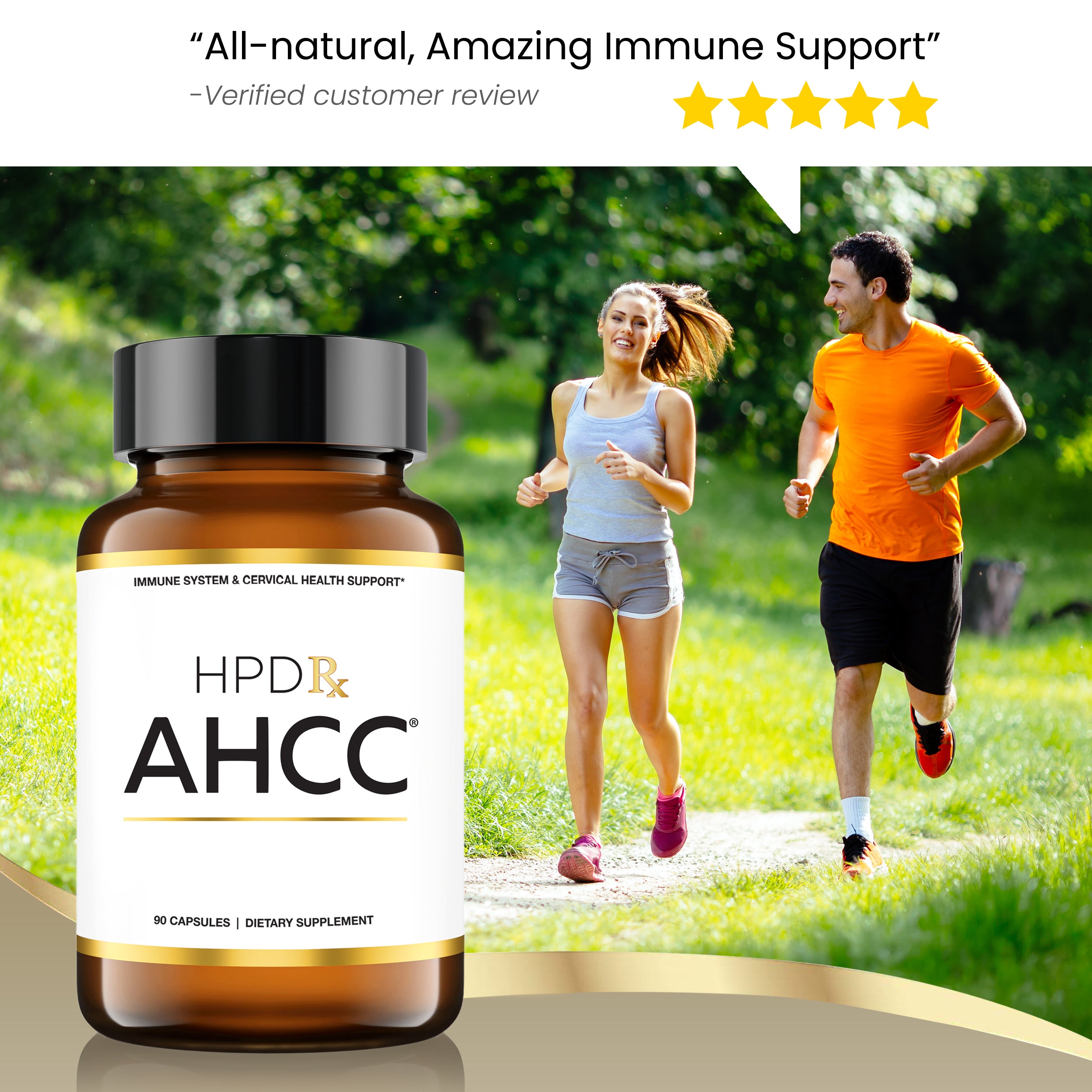
Our HPD Rx AHCC® tells you exactly what you are getting. Each three-capsule serving combines 550 mg of genuine AHCC® from shiitake mycelia with 550 mg of organic shiitake fruiting-body extract. We recommend two servings daily.
We also third-party test our formula and manufacture it in a U.S. FDA-registered facility that follows GMP standards.
Dr. Monte Swarup, MD, FACOG, developed HPD Rx around reproductive and immune health. For women looking beyond generic mushroom supplements, that gives you a physician-formulated way to add authentic AHCC® to your immune routine.
Is AHCC® Worth Trying for Herpes?
It can be reasonable to consider if recurrent outbreaks are a problem and you want extra immune support alongside proven care.
There is enough HSV-specific research to make AHCC® interesting, especially the longer remission reported in people with difficult recurrent herpes.
There is not enough evidence to promise fewer outbreaks for everyone.
That distinction is important. AHCC® has a plausible immune role and encouraging early human findings. Antivirals still have far stronger evidence for controlling the disease itself.
If you decide to try AHCC®, use a genuine product, keep your normal treatment plan, and judge the result over time rather than after one outbreak.
Final Takeaway
AHCC® for herpes is best viewed as immune support with early clinical evidence, not a replacement for antiviral treatment.
A small recurrent-herpes report found fewer outbreaks and remission periods more than 2.7 times longer, while laboratory work found stronger antiviral immune responses.
Those findings deserve attention, but they need larger controlled human studies before AHCC® can be considered a proven herpes treatment.